The Ritchie Effect
TL;DR
The Ritchie Effect is the observation that higher budgets lead to mediocrity. The director Guy Ritchie created his best (and worst) movies with the smallest budgets.
Background
Guy Ritchie is one of my favourite movie directors. I loved the characters and storytelling in Snatch, and have been a fan ever since. After the release of King Arthur: Legend of the Sword, I started to miss the original, clever Ritchie movies. Maybe Guy had lost his touch? But then The Gentlemen hit the screens and it felt like Guy Ritchie was back. What had changed? My guess is that higher budgets constrain creativity.
Observations
The general trend observed in Ritchie’s work is that bigger-budget movies are ‘mid’. More of Guy’s creativity comes through with his lower-budget movies. Sometimes that results in brilliance (e.g. Lock, Stock and Two Smoking Barrels), and sometimes that results in rubbish (e.g. Swept Away).
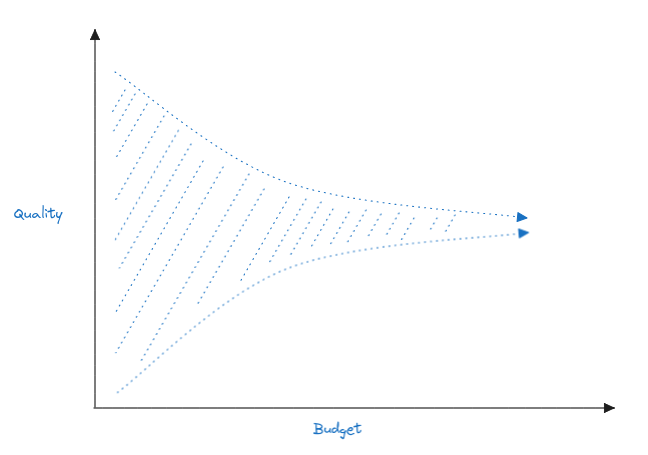
But let’s not take my subjective take. Let’s look at some cold, hard data:
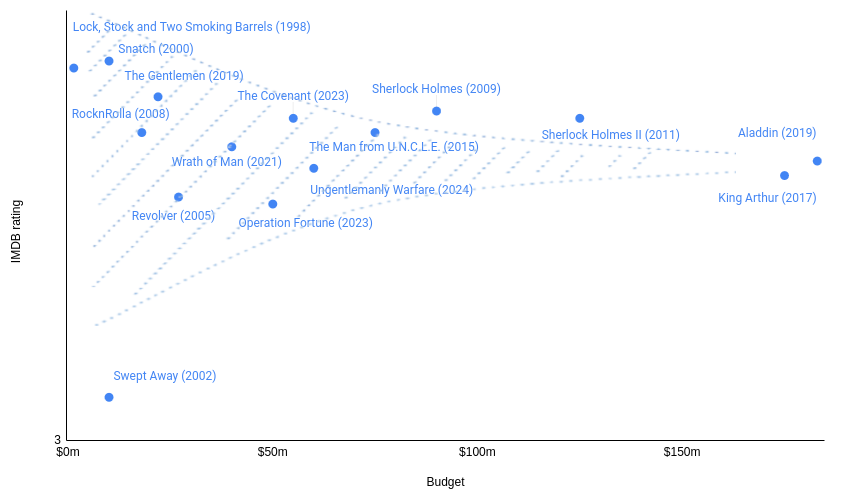
Both of Ritchie’s top two movies as rated by IMDB were produced with a budget of under $10m. Lock, Stock and Two Smoking Barrels was made with just $1m. And let’s pretend Swept Away was never made.
At the other end of the spectrum, Aladdin and King Arthur: Legend of the Sword had budgets of over $175m. These movies could not excite critics and audiences as much as movies with literally 1% of the resources. This leads us to conclude the Ritchie Effect:
It doesn’t end with critics. The most financially successful Ritchie films are also the smaller budget flicks.
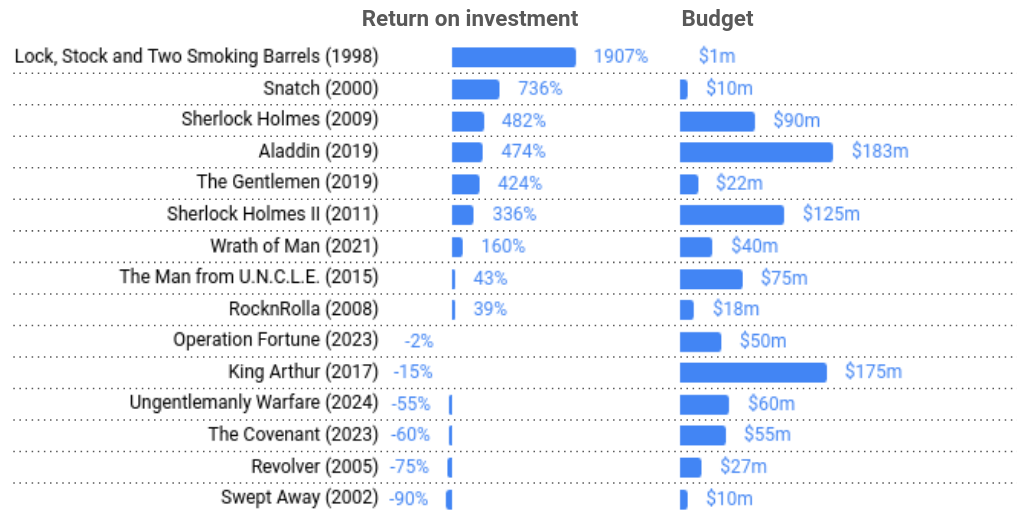
Here, return on investment is defined as the worldwide box office less budget, expressed as a proportion of the budget (marketing and publicity costs are excluded). The second-largest budget film, King Arthur: Legend of the Sword, was a box office flop. There are many factors contributing to box office success. But for Guy Ritchie, it is clear that more money does not contribute to more financial success.